


Hundred JP63 Magnite Badminton String Review
Try the 0.63 mm JP63 Magnite on a fast drive that makes you take one step sideways. A hard-feeling contact can still give you useful length from that small movement.
How should you compare Hundred JP63 Magnite with JP63 Hunter?
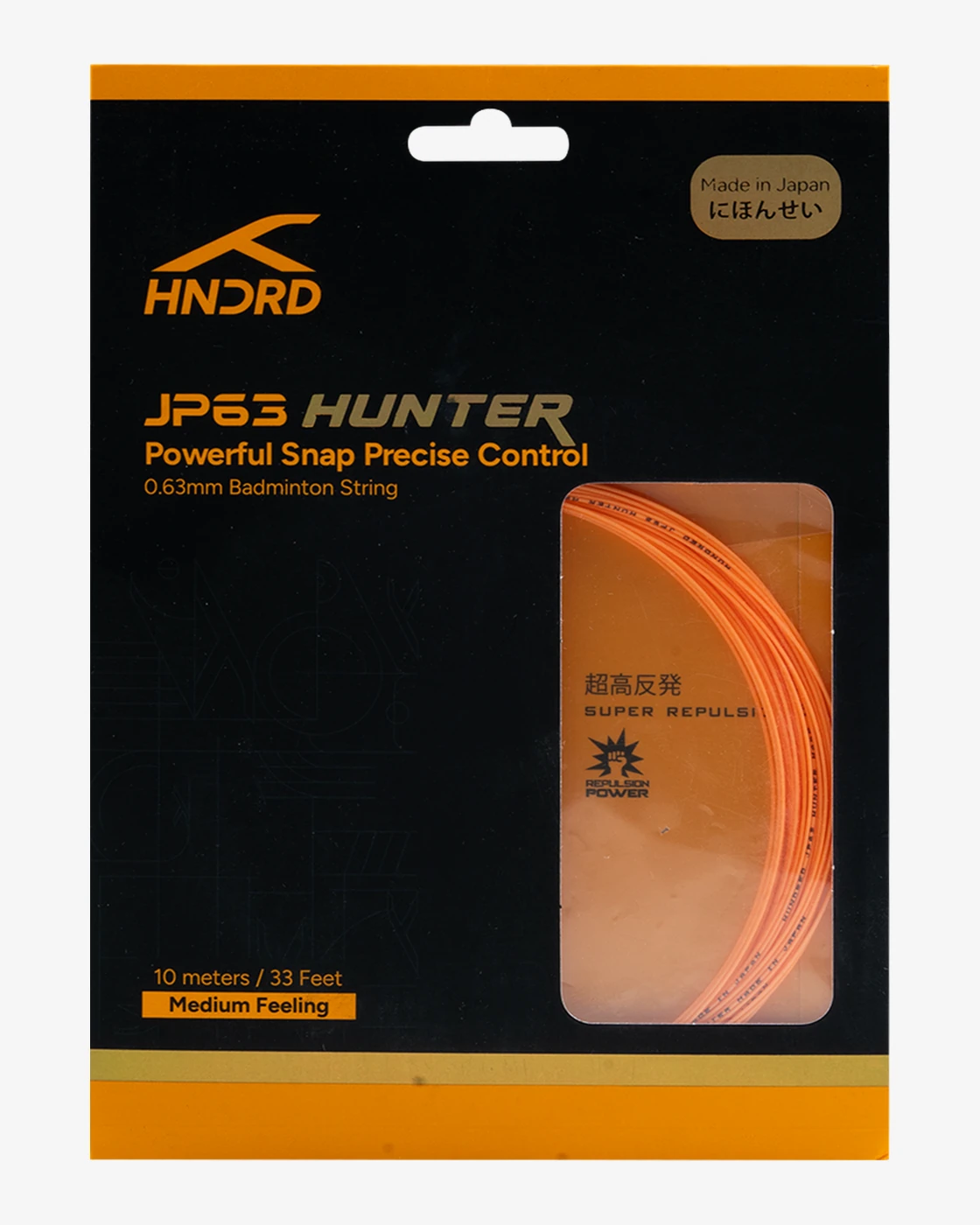
Both Hundred sets are marked 0.63 mm. JP63 Magnite is labelled Hard Feeling and Hundred lists a tight-knit nylon multifilament outer. JP63 Hunter has a different published outer and coating. Try the same drive from a side step and a quiet block in comparable rackets at a familiar tension.
- Model
- JP63 Magnite
- Gauge
- 0.63 mm
- Retail set
- 10 m
- Outer
- Tight-knit nylon multifilament
- Pack marking
- Hard Feeling · Made in Japan
Prepared by ERR Badminton Restring · Hundred India JP63 Magnite specifications · Hundred India JP63 Hunter comparison specifications · Hundred India badminton string catalogue

Check the Magnite pack before the first fitting
The black and orange packet shows JP63 MAGNITE and 0.63 mm on the front. The lower label gives 10 m and Hard Feeling, and a blue badge says Made in Japan. Hundred India describes a tight-knit nylon multifilament outer. Keep the name with that specification when you ask the stringer for a comparison with Hunter.
JP63 Hunter shares the gauge and uses a different outer description. Put the two packet names on your notes before you start. The full name gives us a way to repeat your fitting later without relying on the colour or a memory of what the first shot sounded like.
If you are looking at Hundred JP63 Magnite because you like a firm first contact, I would start with two shuttles in a row. Take the first one around chest height and drive it straight. Have your partner play the next one lower and closer to the net. I want to see if you can let go of the pressure in your fingers quickly enough to play that second shuttle where you mean to.
Have your partner feed six pairs at a pace they can repeat. For the first shuttle of each pair, hit a drive through a channel that is a racket width or two outside the front player's body. For the second, move towards the forecourt and play a short block. Let the player in front judge whether they could reach it above tape height. Give both shots their own scores.
Use natural feather shuttles with matching speed and comparable condition. A worn shuttle may slow enough that you arrive earlier for the short block. Swap it before the next comparison and repeat the pair. If you run another round on a different day, note the court and speeds again. Small changes in feed are worth catching before you attribute the result to the string.

Try the drive with one step less time
Ask your partner to feed a feather shuttle flat toward the outside of your racket shoulder. Move sideways and keep the racket head in front. Use a short motion and aim beyond the person feeding, in the rear half with a little room before the line. Repeat at a pace you would face after standing at base in a game.
Try a few from a slightly wider feed. If the drive lands short, check whether the contact came too far behind your body. Get to one earlier before deciding that you need to change the tension. I would judge the return by its height and landing point, then record whether the impact felt sharper.
A firm touch can arrive before you notice how the stringbed gives the shuttle back. Take the same pair of shuttles several times. Record the sound if you like it, and count how many second replies stay below the tape. If you do well on the first ball and keep leaving a comfortable kill on the next one, that gives me a much more precise fitting question than whether you call the string hard.
Repeat on the side that gives you the least room during a match. If the feeder hits the second ball higher by accident, replay the pair at the usual height. Look at the number of blocks that dropped where you intended, then ask your partner how many of them gave them time to put the racket under the shuttle. Those two numbers can tell you why a ball that looked low from your end still got punished.
Photograph the central crossings and the forecourt contact area before you cut the previous set. Repeat the photos after a few sessions at a similar angle. If you see a mark or cut near a grommet, check the hole while the string is still there. Bring the picture and the playing hours. I want to see whether the affected area is a repeated wear point on your own racket.

Use the pack marking to keep the comparison straight
The words Hard Feeling are useful for identifying which Magnite set you are trying. With the same frame and grip, compare whether the next drive reaches the spot at normal effort. Keep track of the test conditions before changing the starting tension or asking for an extra pound.
For a second trial you can compare JP65 Magnite. Keep the target and feather shuttle the same so the 0.63 mm and 0.65 mm options get the same test. A quick response is useful when the shuttle goes where you plan and you still have time to reset for the next shot.
The Hundred India product page lists the JP 63 Magnite at 0.63 mm and gives a length of 10 m for the single set. It lists Japan as the origin. The two views here identify the pictured JP63 MAGNITE packet. Take a photo before you open your string, particularly if you have ordered another Magnite or Hunter in the same delivery.
Hundred JP63 Hunter is the comparison I would choose if you want to hold nominal gauge at 0.63 mm. Run the two-shot drill before changing the target, and use beds with a similar amount of playing time where possible. The question is how you manage the short block after the drive. A score from the first contact alone leaves out the part that matters for this fitting.
If you use a meter, take a reading after installation, another after the bed has rested and a third after the first session. Keep the meter, spot and timing consistent. Add your drive and short block counts on the same page. If you notice the block changing after two evenings, you will know both how much you have played and what the reading was around that change.

Take pace off when the next shuttle comes lower
After the side-step drive, ask for a quick return toward your hip. Hold the racket out in front and block straight. Aim close enough to the tape that the next player has to lift. Take a few more with a relaxed hand and see how much the slower return changes when the feeder moves slightly closer.
If the reply keeps floating, make a note of where you made contact. Try again at the original height before changing other details. Repeat the same drive and block with your familiar racket and score them separately. You may care more about the second return even if the first one felt lively.
The India page describes its core as firm feeling and lists a nylon multifilament core, an elastic resin coating and a tightly knitted nylon outer. These are the maker's descriptions. The 10 m set is the format we can identify for this review. If a seller offers a cut length, ask for the actual reel label and its product code before assuming you are repeating the same order. Keep that label with the colour and batch.
If you currently play JP65 Magnite, bring that work order as a second reference. That comparison changes gauge as well as model, so I keep it on its own line. Add a high clear after the short drill and check if you still reach your normal rear-court depth. You might be happy to keep the way your current string lifts the shuttle even when another one sounds more distinct on a clean drive.
We still need a matched ERR court and DT series for this model. The manufacturer's retention language belongs with its product specification. A local result needs a repeatable set and the conditions written down. If you bring me your readings, put the detail about the second ball next to them, since your hand can react differently even during two sessions with close DT values.

Look at where the set starts to wear
Photograph the crossings after your normal training or league game. Compare the same area after a similar number of hours under the same light. The area where you regularly catch a drive is worth checking separately from the rest of the bed. Record whether you broke strings there or near a frame hole.
Show the stringer the nearest grommet if the break repeats at the edge. A photo and the racket make that discussion easier. If you alternate between JP63 Magnite and another set, label the jobs and record how much you used each rather than counting calendar days alone.
Start with your familiar frame and the grip you used in your last game. I will check when you started having trouble taking pace off the ball. If it only happened after the previous bed had several sessions on it, write down the hours. If you always have to squeeze before contact, show me your backhand preparation before we select a tension.
Set a normal doubles pace and include two exchanges before the short feed. At first you will probably find the right grip pressure easily. Later in the session, see whether you can still take pace off without stopping the racket abruptly. If your arm starts doing extra work to set the face, note at what point the second reply begins to sit up.
At the end tell me which rally situation used to catch you late. If you can drive through and then keep the next ball below the tape, you have a useful reason to repeat the job. If your first hit felt good and you had to keep correcting the next one, compare your notes with your current setup before you choose a different tension.

Bring a repeatable test to the restring enquiry
Ask ERR about the exact Magnite model and bring the packet if you already have one. Include the frame model and the last tension. Describe which part of the side-step drive or low block you want to preserve. Try those two shots again after the fitting so the result is easy to discuss.
If you log DT, the meter and actual playing exposure belong with the reading. The existing ERR page does not yet publish a measured series for this model. Note how long it has been since installation and keep the same drill when you do your own follow-up.
When the same mains and crosses remain suitable for the frame and its condition, I prefer to start with that known setting. Two frames should be close enough that you recognise the swing before you swap them. With just one, mark a familiar target and run a short baseline drill before replacing the old set. An old bed with a lot of play time is worth documenting as a baseline of your current experience.
Take one round where your partner chooses between a low straight ball and a short crosscourt feed. The choice should happen after your drive. Count which ones you reach without changing how you grip the racket. That test helps if the issue during matches is that your response is always the same because you never have time to prepare for a different direction.
At Setapak I would register the JP63 MAGNITE label, 0.63 mm gauge, supply format and both tension settings. Bring a photo of the label and tell me the time in play before you first noticed a change. For the next installation we can start from the same shot and change one part of the setup at a time.
Hundred JP63 Magnite Knowledge Check
How well do you know this string?
0 / 8 answeredYour result
Review each answer, then try again when you are ready.
| Nominal gauge | 0.63 mm |
|---|---|
| Pack model | JP63 Magnite |
| Retail length | 10 m |
| Pack feel marking | Hard Feeling |
See the response profile
Response and feel
Ask a partner to feed a flat shuttle half a step outside your racket shoulder. Move first, then drive into your normal rear target with a compact action.
Contact, deflection and rebound
Check whether the hard-feeling pack gives you a low, comfortable return after a sideways step. Use the same starting grip for the quiet block that follows.
The numbers behind the feel
Use the published nominal gauge and printed code to identify the set. There is no comparable five-characteristic rating scale in the cited product data.
| Specification | Published value |
|---|---|
| Nominal gauge | 0.63 mm |
| Pack model | JP63 Magnite |
| Retail length | 10 m |
| Pack feel marking | Hard Feeling |
Hundred JP63 Magnite · DT record
ERR measurements are pending. Record DT after stringing, at 24 hours and at 72 hours. Also record how much you played between readings.
- After stringing
- Pending
- 24 hours
- Pending
- 72 hours
- Pending
Hundred JP63 Magnite and three alternatives
Use fresh fittings and comparable frames. Keep the gauge and the shot you want to check in the notes.
| String | Gauge | Construction or feel | What to check on court |
|---|---|---|---|
| Hundred JP63 Magnite | 0.63 mm | Tight-knit nylon multifilament outer | Try a side-step drive and a quiet follow-up block. |
| Hundred JP63 Hunter | 0.63 mm | Nylon monofilament outer on Hundred’s specification | Compare contact on the same feed and at the same tension. |
| Hundred JP65 Magnite | 0.65 mm | Nearby gauge in the Magnite family | Compare the swing effort on a late return. |
| Hundred JP70 Magnite | 0.70 mm | Larger gauge in the Magnite family | Check depth and wear during a regular session. |
Ask a partner to feed a flat shuttle half a step outside your racket shoulder. Move first, then drive into your normal rear target with a compact action.
What would you like to feel differently?
Check whether the hard-feeling pack gives you a low, comfortable return after a sideways step. Use the same starting grip for the quiet block that follows.
Track the change, not just the sound
Record the installation date and playing hours. If you measure DT, repeat the reading with the same meter and method.
Bring this question to ERR →Separate contact from setup
Compare the drive depth again at the end of your games. Record both the effort you used and the landing position.
Bring this question to ERR →The break location matters
Check whether the last break was at a centre crossing, beside a grommet or after a clash. Bring a photo of the location.
Bring this question to ERR →Describe what your hand notices
Check whether the hard-feeling pack gives you a low, comfortable return after a sideways step. Use the same starting grip for the quiet block that follows.
Bring this question to ERR →Inspect before installation
Have the frame and grommets inspected before you agree on the next string or tension.
Bring this question to ERR →Explain the change clearly
Compare the frame, grip and string job with your earlier ticket. Change one condition before repeating the same shot.
Bring this question to ERR →What matters on court?
Choose what you want from your next restring.
Try the first return at familiar effort
Ask a partner to feed a flat shuttle half a step outside your racket shoulder. Move first, then drive into your normal rear target with a compact action.
Ask your stringer. Can we compare the first reply at the same tension?
Record wear and playing time
Compare the location of a mark with the earlier job and keep the time on court beside it.
Ask your stringer. Is the wear near a crossing or a grommet?
Keep comfortable depth
Compare the drive depth again at the end of your games. Record both the effort you used and the landing position.
Ask your stringer. Which setting lets me retain ordinary length with this string?
Keep control of the second contact
Check whether the hard-feeling pack gives you a low, comfortable return after a sideways step. Use the same starting grip for the quiet block that follows.
Ask your stringer. What should I record when changing from a drive to a soft reply?
Different equipment. Different questions.
Different rackets
The same requested pounds can feel different across frame shapes and stringbed dimensions. Record the racket, not just the number.
Try Hundred JP63 Magnite on the same racket first. Record the full racket model and the agreed tension before trying another frame.
Different strings
Gauge, construction and surface feel change the comparison. Do not treat every thin string as the same product.
Compare Hundred JP63 Magnite with Hundred JP63 Hunter using the same racket and familiar shots. Use the table above to check gauge and construction before changing the setup.
Different installation
Machine calibration, support, clamps, pattern and technique can affect consistency. Ask about the process as well as qualifications.
If Hundred JP63 Magnite repeatedly breaks near the same hole, show your stringer a close-up of that spot and ask them to inspect the grommet.
Different sessions
Shuttle speed, hall conditions, fatigue and timing influence feedback. Compare familiar drills before drawing a conclusion.
Use the same shuttle speed and repeat a few clears, drives and net shots. Record playing hours alongside any change in how Hundred JP63 Magnite feels.
Prepare, play and review with purpose.
Bring your racket history
Note your racket model, previous string, requested tension and the change you want. A photo of recurring breakage helps.
Make the plan specific
Review the frame and grommets. Confirm string, colour availability, tension within the racket limit and price before work starts.
Keep a useful record
Keep the string model, requested tension and date together. Ask about the pattern and checks relevant to your racket.
Repeat familiar shots
Try clears, drives, blocks and net shots under comparable conditions. Record comfort, length and placement, not only sound.
Change one thing at a time
Bring your observations back. Keep the setup if it works; otherwise agree on one practical change for the next restring.
Hundred JP63 Magnite frequently asked questions
What is the gauge of Hundred JP63 Magnite?
The packet and Hundred India list 0.63 mm. The retail pack is marked 10 m.
How can I identify the JP63 Magnite packet?
Look for the black and orange pack with JP63 MAGNITE, its blue accent, the 0.63 mm print and the Hard Feeling label.
What construction is listed for JP63 Magnite?
Hundred India identifies a nylon multifilament core, tight-knit nylon multifilament outer and an elastic resin coating.
How do JP63 Magnite and JP63 Hunter differ?
They share a 0.63 mm nominal gauge. Hundred lists different outers and coatings. Compare the same sideways drive and low block in similar setups.
What should I try first with JP63 Magnite?
Try a compact drive after one side step. Check its landing area and the effort it takes before judging the impact sound.
How does JP63 Magnite compare with JP65 Magnite?
JP65 Magnite measures 0.65 mm. Compare the same drive, a quiet block and crossing wear in rackets you know.
Does Hard Feeling determine the right tension?
Choose a starting tension using your racket’s limits and condition and the setting you already know. Discuss any repeated breaks with the stringer.
How can I compare JP63 Magnite wear between sessions?
Photograph the same contact area after a similar number of playing hours. Include the closest grommet if a break occurs at the frame.
Does ERR have publishable DT readings for JP63 Magnite?
The current review has no measured DT series for this model. If you take your own readings, log the meter, age of the fitting and actual time on court.
Does the feel label tell me which string will last longer?
Use your own wear log with the frame, tension and playing exposure. The feel rating describes contact feedback.
Can I select Hundred JP63 Magnite in online booking?
The current ERR catalogue carries it as a review. Contact ERR for availability and fitting options for the exact model.
What should I send in a JP63 Magnite enquiry?
Send the packet photo, racket model, previous tension and a description of the drive or block you want to change.
How did Hundred JP63 Magnite play for you?
Your experience can help another player choose their next string.
If you have played with this string, tell ERR your racket model, tension and what happened on court.
Contact ERRMore badminton string reviews.
Take a closer look at other strings before choosing your next setup.


Ready to discuss your string setup?
Bring the Hundred JP63 Magnite setup you want to try, your racket model and your previous stringing details.
Ask about stock Explore the string listBook stringing.
Bring your racket and questions.
Ask ERR about the Hundred JP63 Magnite set, your racket and the shot you want to repeat. Confirm colour, available fitting times and the current price before visiting.
Ask about stockAsk ERR on WhatsApp ↗Prepare a question for your visit
Open WhatsApp with my question ↗You can review your message in WhatsApp before sending.Ask ERR about the Hundred JP63 Magnite set, your racket and the shot you want to repeat. Confirm colour, available fitting times and the current price before visiting.
Appointments use the existing ERR Member flow, with WhatsApp available for model-specific questions. Confirm the current listed price, colour and availability before travelling to the Taman Melati Utama location in Setapak, Kuala Lumpur. The map identifies the actual appointment location.
Ask ERR about the Hundred JP63 Magnite set, your racket and the shot you want to repeat. Confirm colour, available fitting times and the current price before visiting.
By appointment · Check available slots before travelling.
Find us in Taman Melati Utama
G-3, PV6 Platinum Hill Condo, No. 3 Jalan Melati 3, Taman Melati Utama, 53100 Kuala Lumpur, Malaysia.
Get directions in Google Maps ↗
