


APACS Signature Pro 70 Badminton String Review
Start with a half-paced clear and a lift from low contact. Repeat those shots after normal games to see what timing and effort the Signature Pro 70 asks from you.
Who should try APACS Signature Pro 70?
APACS Signature Pro 70 is a 0.70 mm, 10 m badminton string made in Japan. APACS's Japanese distributor describes a Hard feel and a thermo nylon resin layer. If you want a 0.70 mm set, compare a half-paced clear and a low defensive lift at a familiar tension, then record wear through your usual games.
- Model
- Signature Pro 70 (SIG-P70)
- Gauge
- 0.70 mm
- Retail set
- 10 m
- Origin
- Japan
- Distributor feel category
- Hard
- Manufacturer-listed feature
- Thermo nylon resin between layers
- Pack length marking
- 33 ft (approximately 10 m)
Prepared by ERR Badminton Restring · APACS Malaysia Signature Pro 70 listing · APACS Japan distributor Signature Pro 70 specifications · APACS Malaysia Virtuoso Pro 70 · APACS Malaysia LHI Signature 70 · Yonex BG65 specifications

Read Signature Pro 70 before looking at the gauge
The white-string version uses a dark and red pack with a gold APACS mark and a tall window. Signature Pro 70 appears on the front. Compare that full name with your order because APACS also has Virtuoso Pro 70 and LHI Signature 70 in a similar gauge. Write down the colour as a separate detail. The pack shows 33 feet on the length line. The Japanese distributor specifies 10 m.
The APACS Japanese distributor describes a Hard feel and a thermo nylon resin layer. Use its specifications to identify what has been installed. When you assess durability, your playing hours and the condition of the stringbed provide more specific information about the set in your racket.
When a player asks whether APACS Signature Pro 70 will give them a longer interval between jobs, I will first look at the old bed and ask which shot they want to preserve. Show me your normal drop shot from the back. Then tell me how many sessions took place before the line first started to move or became difficult to control. Those two accounts make a better starting point for the fitting.
Ask your partner to lift six shuttles high enough for you to prepare the same overhead stroke. Aim the drop a little inside the straight side line and in front of the short service line. Use the action you normally use in a rally. Count how many fall where you want and which ones make a front player take the shuttle below the tape.
Use natural feather shuttles with the same speed and comparable condition when you test. A damaged shuttle can change the pace at the net. Swap it before changing rackets. For a wear comparison, give both setups similar work. If one racket is used for back-court drills and the other is used to warm up, the number of sessions alone will miss a difference.

Start with the clear you can repeat
Ask your feeder for a steady lift into the same overhead corner. Drive the shuttle high enough to reach the rear third with a comfortable, half-paced swing. Mark where it lands. If you keep using a longer movement to get depth, check whether you are meeting the shuttle too far behind you.
Repeat with your usual 0.70 mm string or another familiar reference, at similar suitable tension. Compare how much movement you use to reach the same court area. If the sound changes, note it separately from depth. You want a shot you can reproduce throughout a normal game.
If the first hit feels firm, try several of your usual drops and then a low defensive block. If the shuttle still goes short without a bigger grip change, keep that result. Longer wear would be useful to you if there is a playable result left near the end of those sessions. The shots and the hours belong in the same notes.
Follow it with a set of six drop shots across the net from the same starting position. The height of your contact can change the line even when the tension is the same. Mark the shuttles that were late or behind you. Try a repeat group rather than taking the result from the one setup that happened to get a friendlier feed.
Take a picture of three known crossings at the start. Pick the middle and the side where you hit when you arrive late. Return to the same positions a few sessions later, and note notches, movement and any mark near a grommet separately. If the line breaks in one place, leave a view of the hole and the remaining string so I can see what happened.

Compare a low lift from the front corner
Ask for a feed just below net height and use a compact movement to lift deep. Give yourself room to recover, then try again from your regular base position. See how much pressure you need in the hand and whether the lift still clears the opponent's reach if the contact is late.
Run the lift again after several active rallies. A tired player may reach the shuttle at a different height, so ask your partner to watch the feed and position. Record which attempts still reach the rear zone. That gives you an observable result before talking about how hard the string feels.
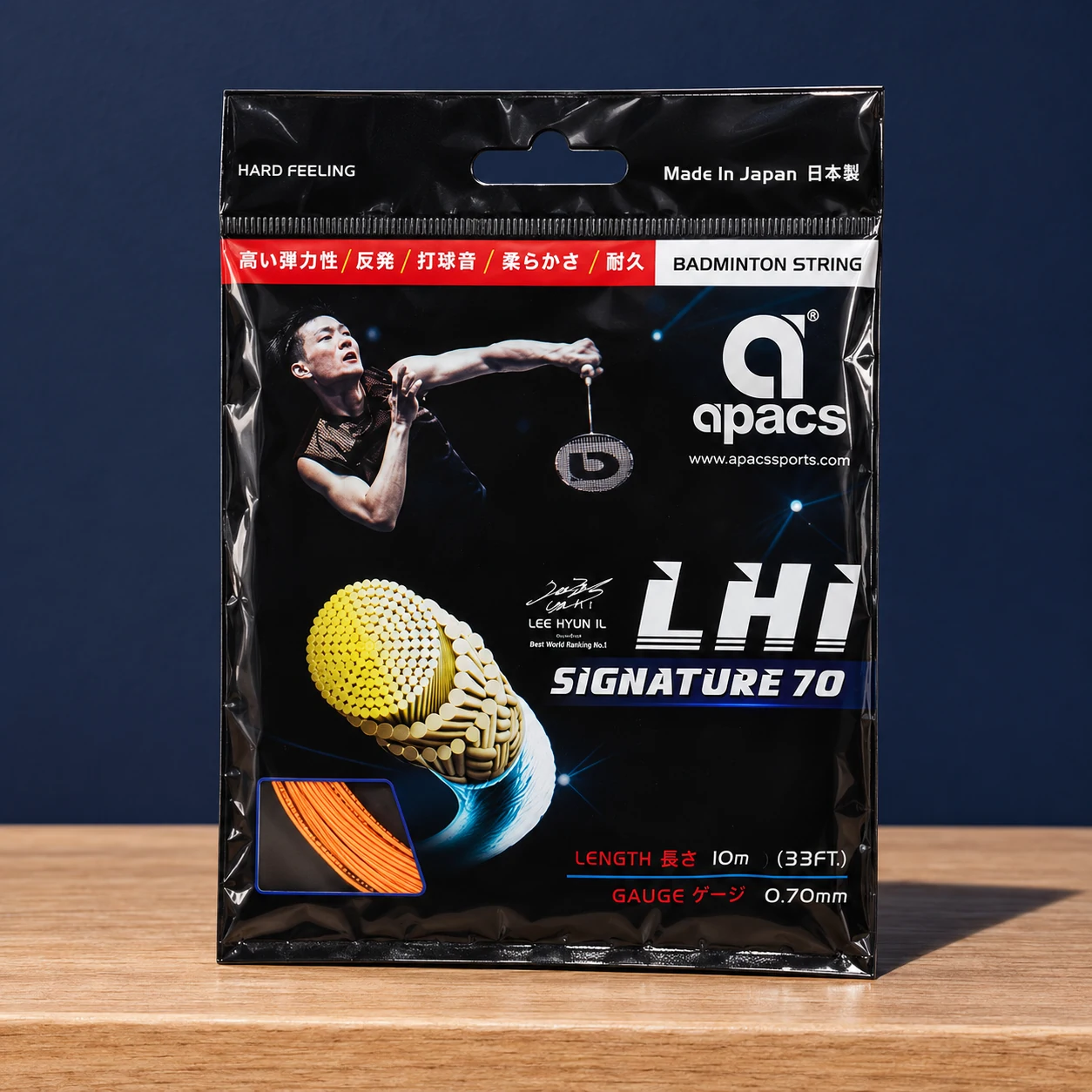
APACS Malaysia lists Signature Pro 70 as Japan Made and shows the red and black family of packaging. The Japan catalogue and Japanese distributor mark the SIG-P70 set as 0.70 mm and 10 m, made in Japan. The two views here show the same model of single set. Read Signature Pro 70 across the front before taking it out of the packet. Japan product listing · APACS Japan catalogue
Yonex BG65 is a handy 0.70 mm reference when you already know how it plays. Note how many hours are on that bed before comparing it with a new Signature set. Start with the same drop and block. A gauge match is a way of making the comparison easier to read, and the drop you want to keep can help you choose which setup to repeat.
If a meter is available, measure at the same point after the job, after a comparable rest and after the first ordinary session. Note the date, the time, the device and playing hours. Write the drop target count and the block height next to it. If you still have a comfortable short ball when the reading has moved, keep both pieces of information.

Keep the same gauge when comparing two models
Yonex BG65 is a familiar 0.70 mm reference for many players. It uses a braided nylon outer as specified by Yonex. If you know it well, start there. Compare a steady clear and lift in the same conditions. Use your landing notes before deciding what changed in the stringbed.
Virtuoso Pro 70 and LHI Signature 70 give you two separate APACS comparisons. Bring the full packet name and reference tension when you discuss them. If you have matched frames, play the same routine in each, then repeat it after ordinary games. This makes it easier to compare both initial response and wear.
The Japanese distributor lists a nylon multifilament construction with resin and describes a firm feel. APACS also sells LHI Signature 70 under its own model name. Put the full label on your stringing ticket so the next person can see which product went into the racket. If you bring us a packet of a different colour, keep the batch and the supply format written next to the gauge.
APACS LHI Signature 70 is a second reference if you want to look at another model from APACS. Label the product separately on your sheet. Try the same six balls, and compare the location of the first wear marks only after a similar amount of use. If the LHI is on your main racket and the other one spends most of the night in the bag, record the difference in playing hours.
There is no matched ERR DT and wear series for this model to quote here. You can use your own readings to follow the racket you play with. Bring pictures at two comparable points in the life of the set. Once we see what changed at the centre and what changed in your short reply, we can discuss whether the next job should remain the same.

Check the same crossings after normal use
Take a clear photo of the central intersections and any other part of the face you regularly hit. Check the same spots after a few sessions. Record what you see beside the time played. Show the stringer where it breaks if a break keeps arriving along the frame rather than in the centre.
After recording a meter reading, go back to the same clear and lift. A note about both shots helps put a change in the reading into context. If you already use the same string in two frames, use one as a reference and record which setup was used in the most recent session.
Bring your usual racket and the previous main and cross numbers. Tell me what made you replace the last string. A break at the frame calls for an inspection of the hole and the grommet. A notch near the centre can be compared against a photo and the playing hours. Where you wear the set matters more to the first decision than a durability rating by itself.
Let a partner send a light smash after you finish a group of drops. Use a short defensive action and see whether the return makes the front player lift. Leave the results next to each other. You may be able to bring the shuttle down precisely from the back but need more time to take pace off when the next one arrives quickly.
At Setapak I will ask which drop you could still place late in your normal session. If it still goes down where you want and the wear is acceptable, save the settings. If you keep adding effort to the block while the old bed looks fine, bring the results and the time in play. That sets up a more precise conversation about the next stringing.

Ask for a specific comparison before booking
Give ERR the full Signature Pro 70 name, your usual setting and the racket you intend to restring. Mention what you need from the clear or lift. If your normal set lasts a particular number of sessions, add the playing hours and any pictures. That gives the stringer a useful baseline.
Check current colour and availability before you reserve a slot. After fitting, use your first practice to repeat the familiar drill and then play normally. Your results over a few games tell you whether the contact, depth and wear fit what you wanted from the restring.
If the frame condition and its limits allow your familiar tension, use that as the first reference. Keep the grip build and how you warm up. If you have two frames with the same build, compare them in the same session and put the same sort of play time on both. With one frame, take a short baseline before you remove the old bed and label its age.
Once you have a familiar feed, let the partner alternate between a faster ball and a lower one. Your return should still go near the target in front of you. Mark the attempts where you changed the grip because you arrived late. I am interested in the ball you can place at the end of a regular session when the work on your hand is greater.
Keep the Signature Pro 70 name, 0.70 mm gauge, 10 m pack, colour and both tension settings with your pictures. We can use the same targets when you come back. Give me the point in the session where you first noticed a change. That tells me what part of the new job we need to verify after you have used it for a similar number of hours.
APACS Signature Pro 70 Knowledge Check
How well do you know this string?
0 / 8 answeredYour result
Review each answer, then try again when you are ready.
| Nominal gauge | 0.70 mm |
|---|---|
| Model | Signature Pro 70 |
| Retail length | 10 m |
| Distributor feel category | Hard |
See the response profile
Response and feel
Hit a half-paced clear into the rear third and lift a separate feed from below tape height. Record both landing points and the effort used.
Contact, deflection and rebound
Start with matched rackets, shuttle type and reference tension. See whether you can reach the target again after several ordinary games.
The numbers behind the feel
Use the published nominal gauge and printed code to identify the set. There is no comparable five-characteristic rating scale in the cited product data.
| Specification | Published value |
|---|---|
| Nominal gauge | 0.70 mm |
| Model | Signature Pro 70 |
| Retail length | 10 m |
| Distributor feel category | Hard |
APACS Signature Pro 70 · DT record
ERR measurements are pending. Record DT after stringing, at 24 hours and at 72 hours. Also record how much you played between readings.
- After stringing
- Pending
- 24 hours
- Pending
- 72 hours
- Pending
APACS Signature Pro 70 and three alternatives
Use fresh fittings and comparable frames. Keep the gauge and the shot you want to check in the notes.
| String | Gauge | Construction or feel | What to check on court |
|---|---|---|---|
| APACS Signature Pro 70 | 0.70 mm | Hard feel listed by the Japanese distributor | Check a half-paced clear and a low defensive lift. |
| Yonex BG65 | 0.70 mm | Braided nylon outer and the same nominal gauge | Use a familiar reference for depth and crossings. |
| APACS Virtuoso Pro 70 | 0.70 mm | Separate APACS model marked Super Hard Feel | Check lift depth with the same approach and grip. |
| APACS LHI Signature 70 | 0.70 mm | Separate APACS Signature product | Read the model code and try the same clear and lift. |
Hit a half-paced clear into the rear third and lift a separate feed from below tape height. Record both landing points and the effort used.
What would you like to feel differently?
Start with matched rackets, shuttle type and reference tension. See whether you can reach the target again after several ordinary games.
Track the change, not just the sound
Record the installation date and playing hours. If you measure DT, repeat the reading with the same meter and method.
Bring this question to ERR →Separate contact from setup
Photograph the same crossing points and keep the readings, hours played and court observations in one record.
Bring this question to ERR →The break location matters
Check whether the last break was at a centre crossing, beside a grommet or after a clash. Bring a photo of the location.
Bring this question to ERR →Describe what your hand notices
Start with matched rackets, shuttle type and reference tension. See whether you can reach the target again after several ordinary games.
Bring this question to ERR →Inspect before installation
Have the frame and grommets inspected before you agree on the next string or tension.
Bring this question to ERR →Explain the change clearly
Compare the frame, grip and string job with your earlier ticket. Change one condition before repeating the same shot.
Bring this question to ERR →What matters on court?
Choose what you want from your next restring.
Try the first return at familiar effort
Hit a half-paced clear into the rear third and lift a separate feed from below tape height. Record both landing points and the effort used.
Ask your stringer. Can we compare the first reply at the same tension?
Record wear and playing time
Compare the location of a mark with the earlier job and keep the time on court beside it.
Ask your stringer. Is the wear near a crossing or a grommet?
Keep comfortable depth
Photograph the same crossing points and keep the readings, hours played and court observations in one record.
Ask your stringer. Which setting lets me retain ordinary length with this string?
Keep control of the second contact
Start with matched rackets, shuttle type and reference tension. See whether you can reach the target again after several ordinary games.
Ask your stringer. What should I record when changing from a drive to a soft reply?
Different equipment. Different questions.
Different rackets
The same requested pounds can feel different across frame shapes and stringbed dimensions. Record the racket, not just the number.
Try APACS Signature Pro 70 on the same racket first. Record the full racket model and the agreed tension before trying another frame.
Different strings
Gauge, construction and surface feel change the comparison. Do not treat every thin string as the same product.
Compare APACS Signature Pro 70 with Yonex BG65 using the same racket and familiar shots. Use the table above to check gauge and construction before changing the setup.
Different installation
Machine calibration, support, clamps, pattern and technique can affect consistency. Ask about the process as well as qualifications.
If APACS Signature Pro 70 repeatedly breaks near the same hole, show your stringer a close-up of that spot and ask them to inspect the grommet.
Different sessions
Shuttle speed, hall conditions, fatigue and timing influence feedback. Compare familiar drills before drawing a conclusion.
Use the same shuttle speed and repeat a few clears, drives and net shots. Record playing hours alongside any change in how APACS Signature Pro 70 feels.
Prepare, play and review with purpose.
Bring your racket history
Note your racket model, previous string, requested tension and the change you want. A photo of recurring breakage helps.
Make the plan specific
Review the frame and grommets. Confirm string, colour availability, tension within the racket limit and price before work starts.
Keep a useful record
Keep the string model, requested tension and date together. Ask about the pattern and checks relevant to your racket.
Repeat familiar shots
Try clears, drives, blocks and net shots under comparable conditions. Record comfort, length and placement, not only sound.
Change one thing at a time
Bring your observations back. Keep the setup if it works; otherwise agree on one practical change for the next restring.
APACS Signature Pro 70 frequently asked questions
What gauge and length are listed for APACS Signature Pro 70?
APACS's Japanese distributor lists 0.70 mm and 10 m. The photographed pack shows the same gauge and gives the length in feet as 33 feet, approximately 10 m.
What does the Signature Pro 70 Hard feel designation mean?
It is the Japanese distributor's feel category. Try a half-paced clear and a lift at familiar settings to see what the contact feels like in your own racket.
What construction detail does APACS give for Signature Pro 70?
The Japanese distributor describes a thermo nylon resin layer between the core and outer fibres. It associates that construction with durability and tension maintenance.
Where is Signature Pro 70 made?
APACS lists it in the Japan-made range. The relevant pack and Japanese distributor both indicate Japan.
What colour choices does APACS Malaysia show?
The brand's Malaysia listing shows white and black. This review shows the white filament variation.
How does Signature Pro 70 compare with standard Yonex BG65?
Both are nominally 0.70 mm. Yonex specifies a braided nylon outer for BG65. Compare the clear and lift while keeping your frame and reference tension as similar as possible.
How is this different from Virtuoso Pro 70?
Virtuoso Pro 70 is a separately labelled APACS 0.70 mm string. Its pack reads Super Hard Feel. Try the same lift and clear to compare how much effort each setup asks from you.
Is Signature Pro 70 the same as LHI Signature 70?
APACS publishes separate listings. Check the complete model name on the front before choosing a set and record the exact packet you use for a court comparison.
How can I assess Signature Pro 70 durability?
Photograph the same crossings after installation and after a few ordinary sessions. Add the time played and ask your stringer to check any repeated edge breaks.
Does ERR have a completed Signature Pro 70 DT series?
The ERR record is pending. Use the same meter at installation, 24 hours and 72 hours, and record when the racket was used.
Does the product's tension rating determine my stringing tension?
Use a tension your stringer confirms is suitable for the actual frame and its condition. The advertised string rating and the racket's limit are different specifications.
Can I ask ERR about Signature Pro 70?
Use the stock enquiry with the full model name, preferred colour, frame and usual tension. Confirm current availability and installed price before booking.
How did APACS Signature Pro 70 play for you?
Your experience can help another player choose their next string.
If you have played with this string, tell ERR your racket model, tension and what happened on court.
Contact ERRMore badminton string reviews.
Take a closer look at other strings before choosing your next setup.


Ready to discuss your string setup?
Bring the APACS Signature Pro 70 setup you want to try, your racket model and your previous stringing details.
Ask about stock Explore the string listBook stringing.
Bring your racket and questions.
Ask ERR about the APACS Signature Pro 70 set, your racket and the shot you want to repeat. Confirm colour, available fitting times and the current price before visiting.
Ask about stockAsk ERR on WhatsApp ↗Prepare a question for your visit
Open WhatsApp with my question ↗You can review your message in WhatsApp before sending.Ask ERR about the APACS Signature Pro 70 set, your racket and the shot you want to repeat. Confirm colour, available fitting times and the current price before visiting.
Appointments use the existing ERR Member flow, with WhatsApp available for model-specific questions. Confirm the current listed price, colour and availability before travelling to the Taman Melati Utama location in Setapak, Kuala Lumpur. The map identifies the actual appointment location.
Ask ERR about the APACS Signature Pro 70 set, your racket and the shot you want to repeat. Confirm colour, available fitting times and the current price before visiting.
By appointment · Check available slots before travelling.
Find us in Taman Melati Utama
G-3, PV6 Platinum Hill Condo, No. 3 Jalan Melati 3, Taman Melati Utama, 53100 Kuala Lumpur, Malaysia.
Get directions in Google Maps ↗
