


ProKennex Pro Flex 66: String Guide & Stringing in Setapak KL
ProKennex Pro Flex 66 is a 0.66 mm multifilament badminton string with a nano-elastomer coating. Learn how to identify its 10 m packet and compare comfortable response, placement and wear before restringing at ERR in Setapak.
What is ProKennex Pro Flex 66?
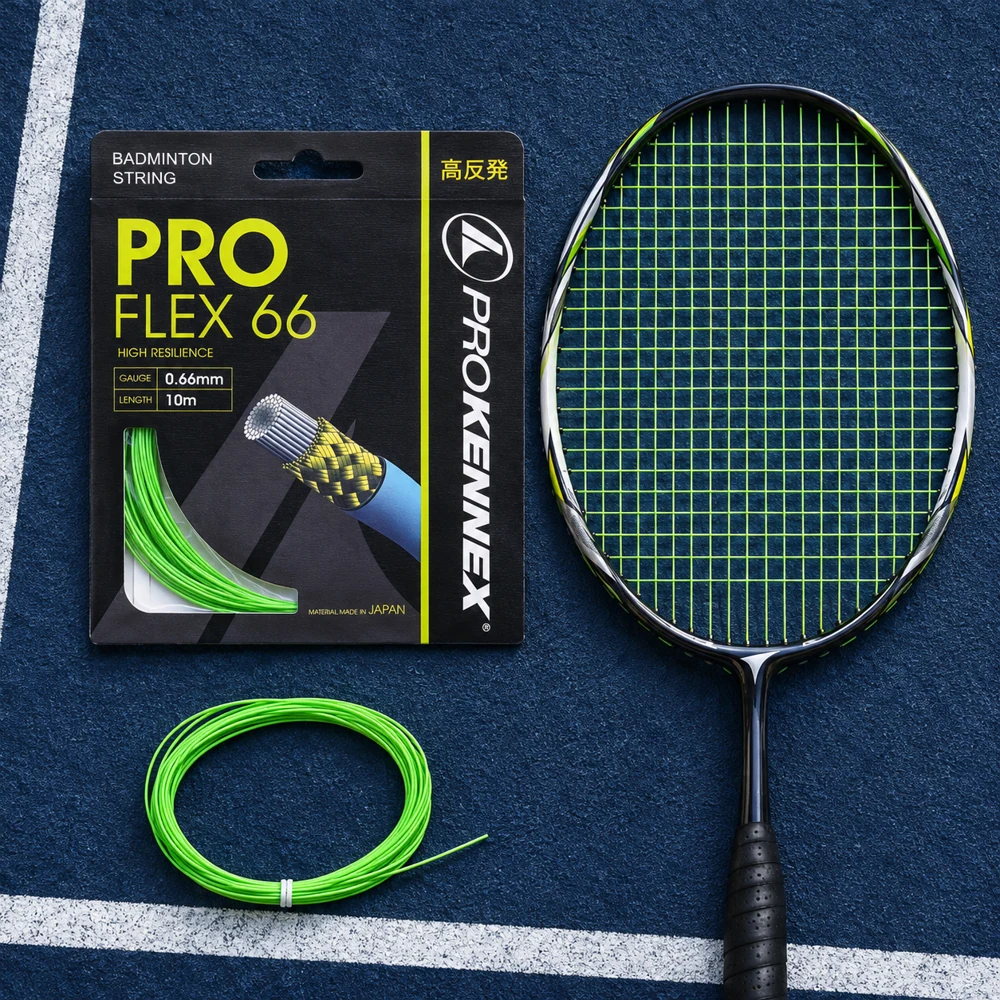
Pro Flex 66 uses a multifilament centre core with fine surrounding fibres and a nano-elastomer coating. ProKennex positions it for response with a softer feel. The nominal diameter is 0.66 mm. The retail packet pictured here contains a 10 metre set and identifies the string by the full Pro Flex 66 name.
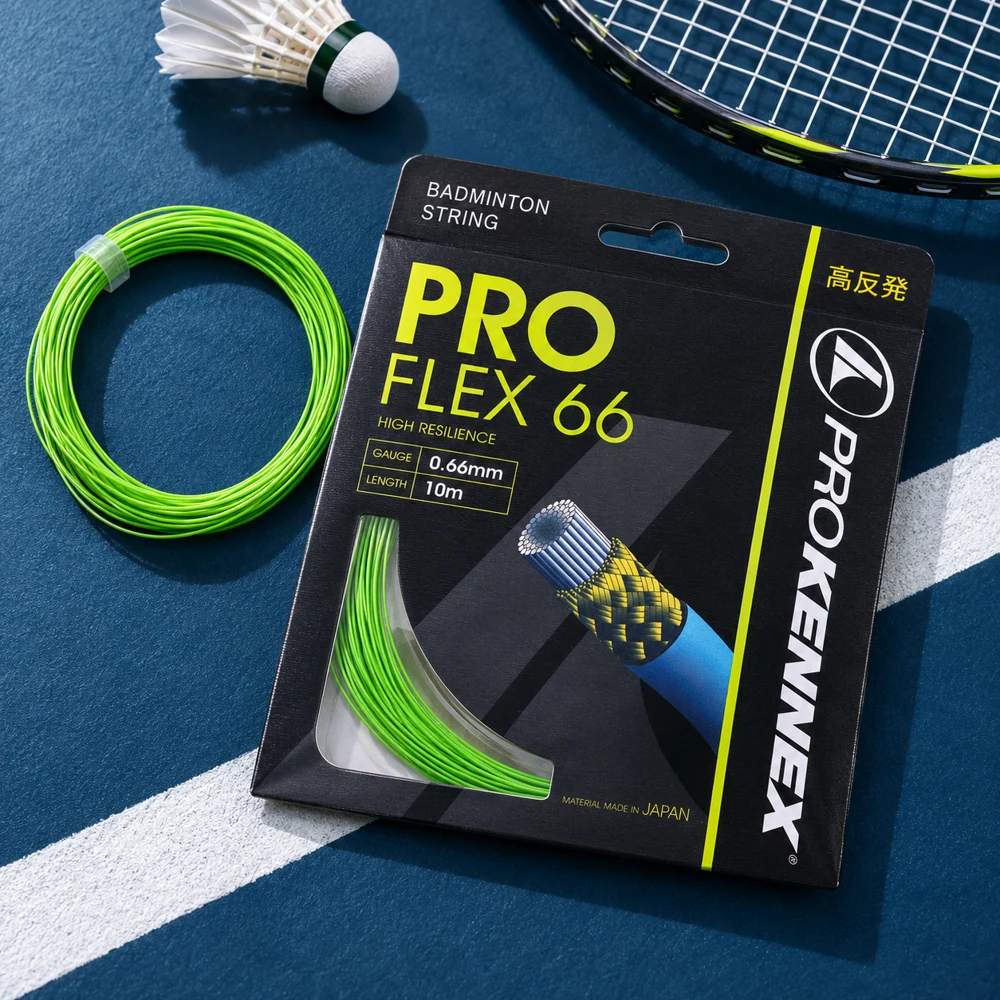
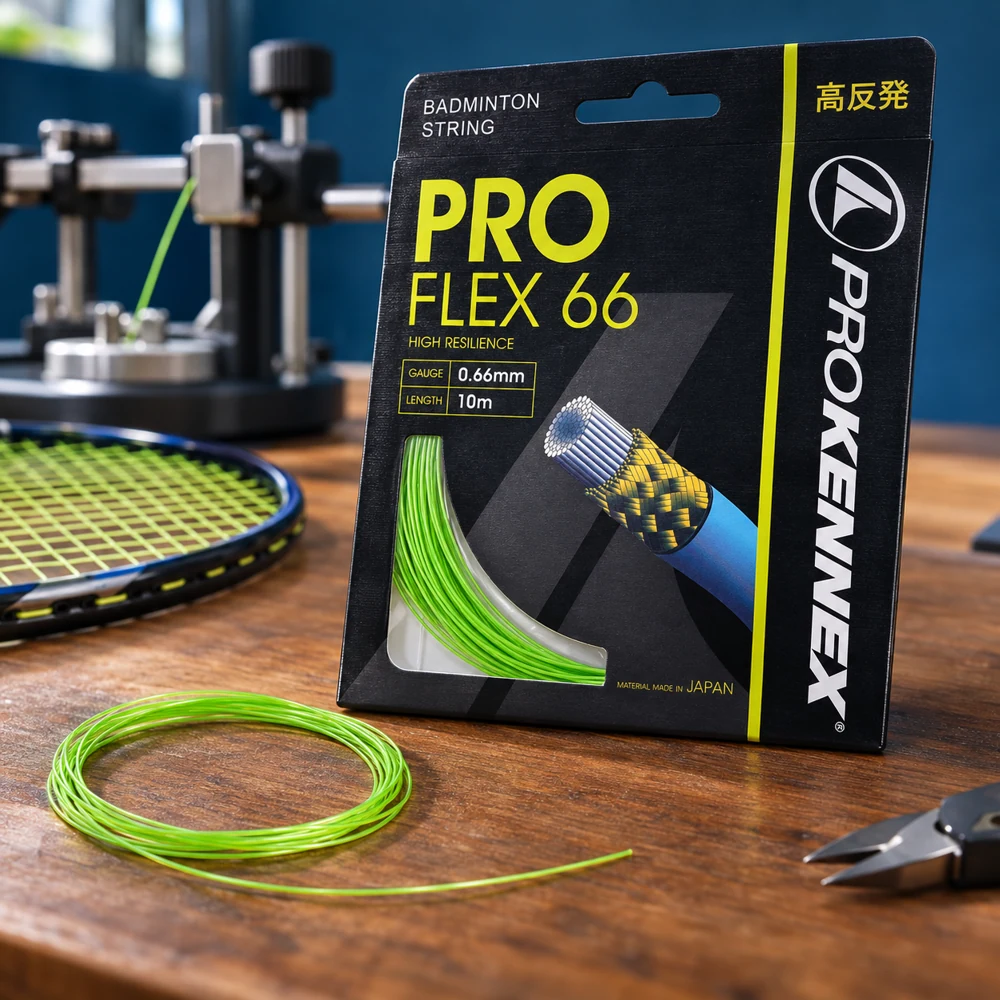
Look for the black packet with the lime Pro Flex 66 name and the vertical ProKennex mark. That visual check helps if you bring a previous receipt or have more than one old packet at home. The manufacturer lists Rainbow Pro separately. Verify its gauge from the exact packet you are comparing. Ask for the name printed on the exact packet you want fitted.
The useful starting question is how clearly you can find a familiar length at ordinary effort. A softer-feeling response can be pleasant, but much of what reaches your hand comes from the finished racket and your contact. Use one familiar racket to explore the feel, and explain whether drives, lifts or short placement matter most to you.
Try the response at two speeds
Start with a repeatable waist-high feed and drive across the court. Try to land several shuttles in a similar lane without increasing grip pressure. Then reduce the pace and send the same feed just over the net. Keep the two observations separate. The effort used on your drive and the precision of the slower return answer different questions.
If you play doubles, include a defensive backhand lift from just in front of the body. Compare how confidently the shuttle reaches depth from that short action. If the new bed feels easy on your forehand but the backhand goes short, ask your partner to repeat the feed before deciding whether the setup needs changing.
For a singles comparison, use a comfortable rear-court clear and an ordinary drop you can perform without forcing the stroke. Record your normal landing point first. Judge how quickly you can recover after making the change in pace. A useful string gives you the response you can repeat during a rally.

Read the 0.66 mm construction
The diameter helps identify the model and compare it with similar products. It says little by itself about the surface you will feel or how the racket will respond after installation. The Pro Flex 66 construction is the combination of its core, surrounding fibres and outer coating, along with your racket and selected setup.
Compare Pro Flex 66 with Pro Flex 63 if the purpose of your trial is to see whether a thinner option fits your preferred contact. If comparing Rainbow Pro, confirm the marked diameter on its packet. BG65 gives you a familiar 0.70 mm option if you want to explore a different maintenance trade-off.
Record the exact model and how long the bed had been in play. If your current string is already well worn, the difference you feel against a fresh Pro Flex 66 installation is a comparison of two setups at different stages. An additional observation after several sessions gives you a better idea of what you generally prefer.
Choose tension for the frame you bring
Take the racket along with the last requested tension and the string you used. Check the frame, grommets and applicable stringing limits before setting up the comparison. If your current length is comfortable, tell the stringer which strokes you would like to preserve and whether you are mainly changing the string to explore a different contact feel.
Think back to the point where your current racket became demanding. Was it short length when you were late, a high block under pressure, or an unpleasant impact when contact moved away from the centre? A description of the stroke gives the stringer something specific to test and helps you decide which setting to try.
Keep the model and requested machine tension on the same record but in separate fields. Repeat a few drives and one easy clear with the new installation. If you change both the model and the requested tension, make that clear when you compare the outcome or mention it at your next appointment.

Check where wear develops
Look near the centre intersections after a few normal sessions. Mark the first visible notches or fraying and where they are in relation to your usual contact area. A frequent break near the same frame hole calls for a closer inspection of the grommet and surrounding area. A photograph before the string is removed helps locate the break.
Playing hours give more context than the calendar date of the restring. A club evening with fast doubles and a shorter drilling session can put very different wear on a stringbed. Take a note of how much you played when you first notice slippage, wear or a loss of the response you preferred.
If you collect readings, record your instrument and repeat measurements under similar conditions. Put those readings next to a brief note about your usual clear or return length. A consistent playing check gives you a useful picture even if you do not own an instrument. Bring the racket for inspection when damage or edge breaks recur.

Who should try Pro Flex 66?
Consider it if the way the shuttle comes away from the racket on a compact swing matters to your game. It is worth comparing if your current setup feels too demanding on easy clears or if you want to see how a softer contact sensation works with your usual grip on blocks and net pushes.
Choose a sensible alternative based on the question you have. Use Pro Flex 63 for a thinner family comparison, Rainbow Pro to compare a separately named product and BG65 to explore a different wear and feel trade-off. Keep your racket and shuttle familiar and check the same two or three ordinary strokes on each.
Before visiting ERR, bring your racket model, current string, last requested tension and the one issue you want to improve. If you are contacting ERR after a break, include a photo of the area. Confirm the available colour and installed fee before travelling to Taman Melati Utama in Setapak.
Pro Flex 66 Knowledge Check
How well do you know this string?
0 / 8 answeredYour result
Review each answer, then try again when you are ready.
| Nominal gauge | 0.66 mm |
|---|---|
| Product code | Pro Flex 66 |
| Retail set length | 10 m |
| ERR restring | Ask ERR for the current price |
Pro Flex 66 feel and construction
Multifilament core
Fine fibres surround the centre core. ProKennex adds a nano-elastomer coating.
Try a drive and a soft push
Check whether you can repeat both return lengths at the pace you normally use.
How the 0.66 mm string fits your game
The softer contact is worth comparing at normal effort. Test a familiar clear and compare how it feels when your contact is slightly late.
Multifilament core
Fine fibres surround the centre core. ProKennex adds a nano-elastomer coating.
Track your Pro Flex 66 setup
Record the stringing date, requested pounds and the racket model. If you use a meter, add the instrument and the time since installation. Keep playing hours and a short note about clear length or gentle returns alongside the readings.
Pro Flex 66 and three alternatives
Compare construction and priorities rather than treating a model name as an upgrade ladder. These are different options, not a controlled ranking.
| String | Gauge | Construction or feel | What to check on court |
|---|---|---|---|
| Pro Flex 66 | 0.66 mm | Multifilament core with a nano-elastomer coating | Compare a compact drive with a gentle return. |
| ProKennex Pro Flex 63 | 0.63 mm | Thinner ProKennex model | Check response at your ordinary swing speed. |
| ProKennex Rainbow Pro | 0.63 mm on the current manufacturer page. Confirm the pack. | Separate model with its own manufacturer listing | Check the marked gauge and compare contact feel. |
| Yonex BG65 | 0.70 mm | Braided nylon outer, durability positioning | Check how maintenance and softer touch fit your game. |
Compare Rainbow Pro as a separate model, Pro Flex 63 for a thinner family option and BG65 when upkeep matters.
ProKennex Pro Flex 66 specification · ProKennex Rainbow Pro specification
What would you like to feel differently?
Describe the stroke you want to improve. Start with your usual clear length, compact defence and the feel of a short block.
Track the change, not just the sound
Some settling after stringing is normal. Record when the racket starts to feel different, the hours played and storage conditions. Compare readings using the same method; a phone frequency reading is not the machine setting in pounds. Ask about installation consistency before assuming a different packet will solve it.
Bring this question to ERR →Separate contact from setup
A stiff-feeling bed, late contact, shuttle speed and technique can all make length difficult. Start with relaxed clears and describe where the shuttle lands. Review your current tension within the racket limit rather than increasing it automatically.
Bring this question to ERR →The break location matters
A break near the same grommet deserves a frame and grommet check. Breakage after off-centre contact differs from gradual notching in the centre. Bring the racket and a photo of the break; do not assume every early break means the string is defective.
Bring this question to ERR →Describe what your hand notices
Tell the stringer which shots feel unforgiving and when the sensation began. Compare contact consistency, string choice and tension. Stringing advice is not a treatment for persistent pain; stop playing through pain and seek appropriate assessment.
Bring this question to ERR →Inspect before installation
Photograph existing chips and discuss cracks, worn grommets and frame shape before work begins. Correct support, the appropriate pattern and staying within the racket limit matter. A chipped finish alone does not establish who caused damage.
Bring this question to ERR →Explain the change clearly
Grip size, balance, racket weight, stringbed response and timing are different things. A restring does not turn a head-heavy racket into a head-light one. Tell the stringer what changed and compare with your previous setup instead of asking only for more power.
Bring this question to ERR →What matters on court?
Choose what you want from your next restring.
Check your drive at two speeds
Play your normal drive and a softer push from similar feeds. Compare whether both lengths come from your usual grip.
Ask your stringerWould Pro Flex 66 suit my compact response on both shots?
Use wear location in the comparison
Note hours played and where you first see wear. An edge break at one hole calls for a frame check before you compare a larger diameter.
Ask your stringerIs my break pattern a reason to change the string or check the grommet?
Keep the familiar clear in the trial
Try normal and slightly late clears. Ask how to keep the depth you already like while exploring the new string's softer contact.
Ask your stringerWhich familiar setting gives me a fair first trial?
Check both packet gauges
If comparing Rainbow Pro, note both packet labels and marked gauges before testing contact and placement. Try one gentle stroke and one at your usual rally pace.
Ask your stringerWhat should stay constant across a Pro Flex 66 and Rainbow Pro comparison?
Different equipment. Different questions.
Different rackets
The same requested pounds can feel different across frame shapes and stringbed dimensions. Record the racket, not just the number.
Compare BG65 on the same racket first. Record the full racket model and the agreed tension before trying another frame.
Different strings
Gauge, construction and surface feel change the comparison. Do not treat every thin string as the same product.
Try BG65 Titanium if you want to compare two 0.70 mm strings with a different outer finish. Use the same racket and familiar shots.
Different installation
Machine calibration, support, clamps, pattern and technique can affect consistency. Ask about the process as well as qualifications.
If BG65 repeatedly breaks near the same hole, show your stringer a close-up of that spot and ask them to inspect the grommet.
Different sessions
Shuttle speed, hall conditions, fatigue and timing influence feedback. Compare familiar drills before drawing a conclusion.
Use the same shuttle speed and repeat a few clears, drives and net shots. Record playing hours alongside any change in feel.
Prepare, play and review with purpose.
Bring your racket history
Note your racket model, previous string, requested tension and the change you want. A photo of recurring breakage helps.
Make the plan specific
Review the frame and grommets. Confirm string, colour availability, tension within the racket limit and price before work starts.
Keep a useful record
Keep the string model, requested tension and date together. Ask about the pattern and checks relevant to your racket.
Repeat familiar shots
Try clears, drives, blocks and net shots under comparable conditions. Record comfort, length and placement, not only sound.
Change one thing at a time
Bring your observations back. Keep the setup if it works; otherwise agree on one practical change for the next restring.
Pro Flex 66 questions, clearly answered.
What is the diameter of ProKennex Pro Flex 66?
The nominal diameter is 0.66 mm. The gauge appears on the Pro Flex 66 packet. Compare the name as well as the gauge when identifying it, because ProKennex lists Rainbow Pro as a separate product.
How long is a single set of Pro Flex 66?
The retail packet shown here specifies 10 metres. If you want to repeat a previous job, ask your stringer to record the exact name from the original pack or reel alongside your setup.
What is Pro Flex 66 made from?
ProKennex describes a multifilament centre core surrounded by fine fibres and finished with a nano-elastomer coating. The package drawing illustrates the construction. Use a court trial to decide how the finished stringbed responds in your own frame.
Is Pro Flex 66 the same as Rainbow Pro?
ProKennex lists them separately. The current Rainbow Pro product page gives 0.63 mm, while older listings have reported 0.66 mm. The current Pro Flex 66 packet has a lime name and a vertical ProKennex mark. Use the full name when you book to make sure you get the intended string.
What tension should I request for Pro Flex 66?
Start with your racket’s permitted limits and the setting you already know. Bring the frame and prior stringing record. Your stringer can check the frame and discuss what you want to keep before recommending a suitable trial.
How can I compare Pro Flex 66 with Pro Flex 63?
Use a familiar racket and shuttles, then choose two drills you can repeat. One could be a short flat drive and the other an ordinary clear. Try the 0.63 mm option when thinner diameter is a specific part of the comparison.
What if my clears still fall short?
Try several clears from a comfortable feed and a few when the feed arrives late. Tell your stringer whether the issue happens only on the late contact or in both situations. Review the prior setup before changing again.
Where should I check for wear?
Look at the crossings near the part of the stringbed you normally hit and at the frame edge. If the same grommet repeatedly breaks the string, have the frame and grommet inspected and bring a photo of the break position.
How can I track changes after the restring?
Note the new string, tension, date and hours played. Repeat an easy clear and a short reply each session. If you use a meter, record its unit and method separately from the machine setting for the job.
Does ERR have Pro Flex 66 in stock?
Ask ERR about the exact model and colour before travelling. Bring an original pack or photo if your old receipt just says ProKennex or 0.66 mm, so the stringer can identify what you want.
How much does Pro Flex 66 stringing cost?
Ask ERR for the current installed fee and colour availability. If your racket needs a grommet or frame check, mention the condition when you ask about the appointment.
What should I bring to the Setapak appointment?
Bring your racket, stringing record and the detail you most want to improve. If you are replacing a broken bed, include a photograph of where it first broke. A brief note about recent playing hours can help too.
How did ProKennex Pro Flex 66 play for you?
Your experience can help another player choose their next string.
What players say
Your first-hand experience matters.
Be the first to review ProKennex Pro Flex 66. Share what you liked and what could be better.
More badminton string reviews.
Take a closer look at other strings before choosing your next setup.

Ready to discuss your string setup?
Bring your previous setup and tell ERR how your usual clears and blocks feel. Use the full Pro Flex 66 name when you enquire.
Book stringing Explore the string listBook stringing.
Bring your racket and questions.
Discuss your Pro Flex 66 setup with ERR before visiting. Tell us your racket model, previous tension and the shot or feel you want to review.
Book through ERR MemberAsk ERR on WhatsApp ↗Prepare a question for your visit
Open WhatsApp with my question ↗You can review your message in WhatsApp before sending.Tell ERR the full model name when you enquire. Include the racket model, prior setup and playing frequency so the visit can focus on the comparison you need.
Bring a break photo if one frame hole has caused repeated problems. Show the previous stringing record when you want to retain a setting that was comfortable.
Confirm the installed fee, colour and appointment before you travel to ERR in Taman Melati Utama.
By appointment · Check available slots before travelling.
Find us in Taman Melati Utama
G-3, PV6 Platinum Hill Condo, No. 3 Jalan Melati 3, Taman Melati Utama, 53100 Kuala Lumpur, Malaysia.
Get directions in Google Maps ↗
