


Gosen G-Tone 58: String Guide & Stringing in Setapak KL
Gosen G-Tone 58 (BS058) is a 0.58 mm badminton string with high-resilience positioning. Confirm the exact packet, inspect wear points and weigh thin-string response against maintenance before choosing it for a Setapak restring.

Confirm the BS058 packet
The inspected manufacturer packet identifies G-Tone 58, code BS058, 0.58 mm gauge, a 10 m set and Japan manufacture. Its front carries high-resilience and power positioning; the rear names Micro Fusion. These basic details also match ERR’s existing catalogue packet.
The former manufacturer web page is no longer accessible at the checked address. Retailer descriptions give nylon multifilament with high-strength quattro-fiber wraps, but a readable current manufacturer technical document was not recovered. That detailed recipe is kept as a retailer description rather than upgraded to independently confirmed specification.
Ryzonic 58 appears in the current Gosen catalogue under BSRY58. It is not another spelling of BS058. Do not use Ryzonic construction, tension-retention claims or reviews to fill gaps in G-Tone 58 information simply because both names contain 58.
Read BS058 and the 0.58 mm specification together when you check the packet. It can be easy to remember G-Tone and miss the version in a crowded racket bag. That distinction is especially useful when you order a backup set or change to another gauge after a first trial.

Explore response without assuming effortless power
G-Tone 58 is a relevant discussion when a very thin, response-oriented string interests you. Its nominal diameter is a clear fact; an automatic improvement in clear length, smash speed or defensive timing is not. Those outcomes still depend on contact and the complete setup.
Start with ordinary clears and compact lifts that you can repeat. Notice whether useful depth arrives with a comfortable action, and whether blocks stay at the intended pace. A lively sensation on one shot is not enough if softer returns become difficult to place.
No controlled independent G-Tone 58 speed or acoustic comparison was verified for this guide. Sound and resilience language is product positioning. It should lead to a practical trial, not to a promise that the thinnest available string is the best choice for every player.
A useful first exercise is a series of compact blocks down the line, using one feed and your normal grip. When those are predictable, move into a quicker drive exchange. Keep track of whether you are comfortable when you slow down after deliberately taking several shuttles fast.

Give wear points extra attention
A 0.58 mm choice deserves a deliberate maintenance discussion. Diameter alone cannot predict the number of sessions before breakage, but a player already frustrated by frequent replacement should compare a thicker alternative as well as another very thin string.
Ask where previous breaks occurred. A repeated failure beside the frame needs a grommet and contact-point inspection; central notching raises a different discussion about use and wear. A packet’s power claim does not solve a damaged support point.
Keep your racket away from unnecessary heat and inspect visible wear between sessions. Do not continue simply because the string has not yet snapped if frame damage is suspected. A new string cannot restore structural safety to a cracked racket.
When you compare with G-Tone 5, test the drive from both a comfortable shoulder-height feed and an awkward lower one. Notice whether the smaller gauge asks for more concentration to keep the same landing zone after a sustained series of exchanges.
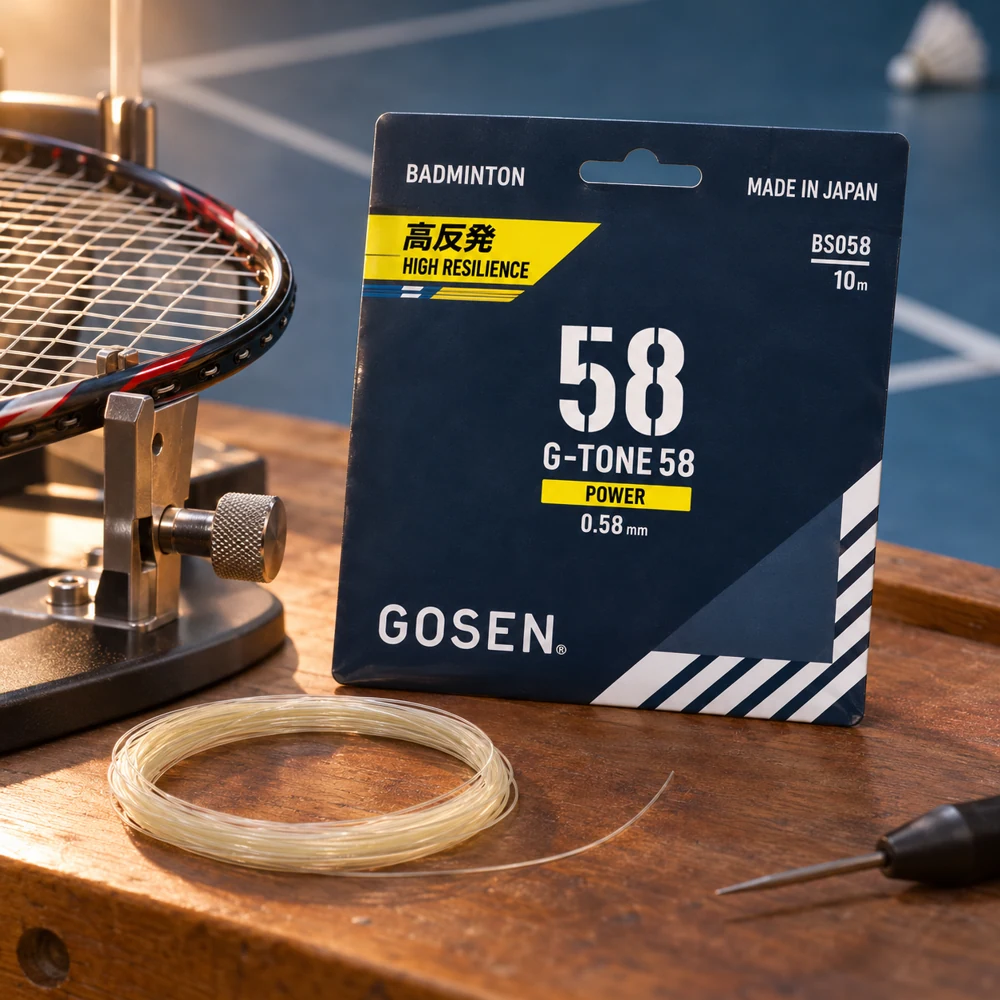
Choose pounds from the actual racket
Retail listings reproduce an 18–27 lbs guidance range for G-Tone 58. It is not a personalised recommendation, and the exact racket manufacturer’s limits and frame condition remain essential. The packet’s demographic chart is not used here to assign pounds by gender or age.
Bring your current string and setting, playing frequency and desired change in feel. If you are changing from a much thicker string, explain what you already like about the existing response. Avoid changing several variables simply to chase a sharper sound.
The stringer must consider the applicable pattern, knots, equipment procedure and any frame concerns. There is no universal pre-stretch percentage or main-and-cross offset in this guide. A consistent first trial makes subsequent feedback easier to interpret.
A large change from a thick string makes many aspects of the response feel new at once. Stick with the familiar racket and normal drill where possible and let your stringer check the frame's limits. Decide after several sessions whether to change the setup again.

Build a genuine response record
No verified ERR G-Tone 58 DT time series was found in the checked project material. The tracking section therefore records what a useful future observation requires instead of borrowing G-Tone 5 data or drawing an invented retention curve.
Record racket model, exact string code, installation setting and date, then note measurement method, units and elapsed time. Include actual playing exposure and storage. A phone-frequency estimate, a DT reading and machine pounds are different quantities.
Add observations of clear depth, soft returns and visible wear. These can support a later discussion of whether to keep the setup or change one element. They do not turn a few personal readings into proof of a universal lifespan or cross-brand ranking.
Keep a closer eye on the frame edge and the hitting area during the first few sessions. If the string fails, log the exact position while you can still see it. That observation will be useful if you next compare G-Tone 58 with G-Tone 5.
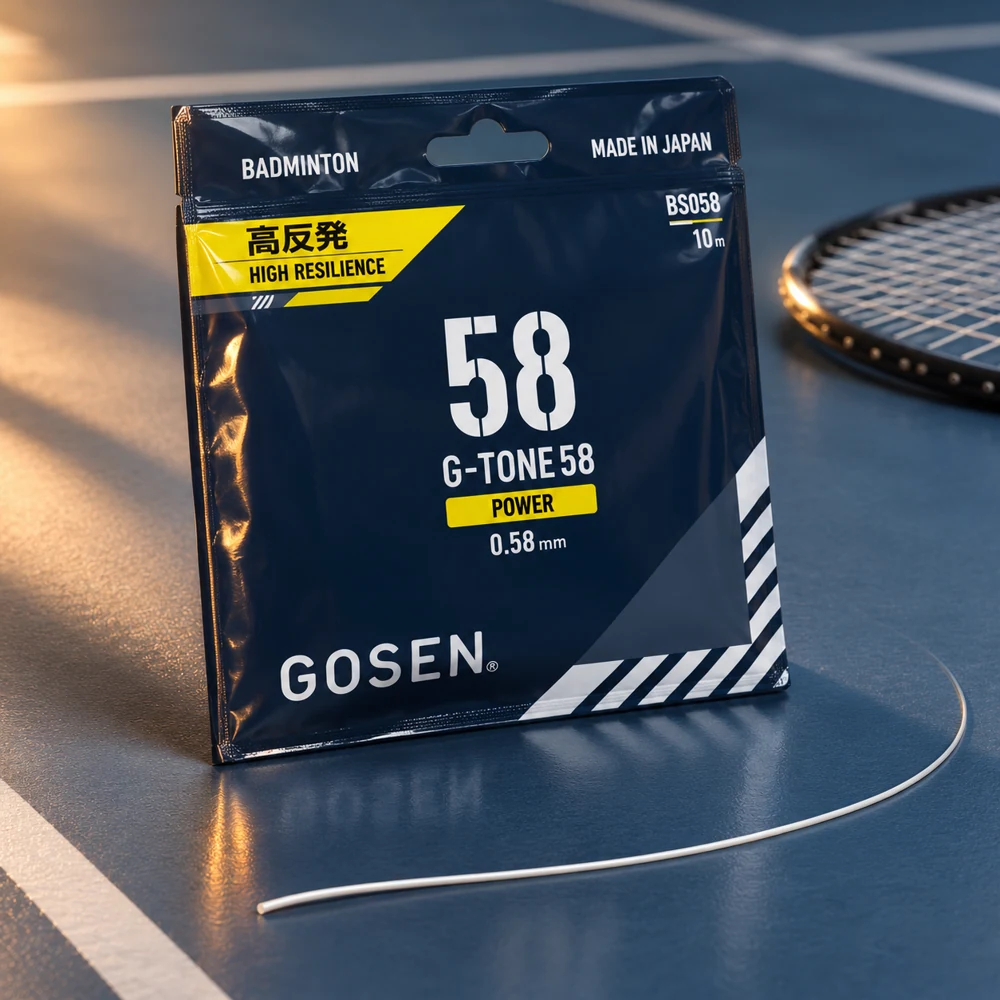
Compare thin options and a wider step
Kizuna Z58 is another nominal 0.58 mm option, with its own manufacturer-described nylon core and braid. Equal diameter gives a useful comparison point but does not establish identical material processing, installed stiffness or replacement interval.
Yonex Aerosonic is a 0.61 mm quick-response option with its own documented construction. G-Tone 5 moves to 0.65 mm within the Gosen family. Either may be worth discussing if you want to compare response while moving away from the very thinnest gauge.
No matched test in this guide establishes which lasts longer on your racket. Compare your normal shots and maintenance priorities, and keep the setup context as consistent as practical. Avoid using separate brand profile bars as though they were one laboratory scale.
G-Tone 58 Knowledge Check
How well do you know this string?
0 / 8 answeredYour result
Review each answer, then try again when you are ready.
| Nominal gauge | 0.58 mm |
|---|---|
| Product code | BS058 |
| Retail set length | 10 m |
| ERR restring | RM40.00, string and labour |
Very thin gauge and maintenance priorities
Inspected packet identity
- Code
- BS058
- Gauge
- 0.58 mm
- Length
- 10 m
- Origin
- Japan
What to assess
Include compact lifts and gentle blocks alongside ordinary clears.
Micro Fusion and high resilience are named on the packet; they do not establish a measured improvement for your racket.
No verified model-specific ERR DT time series or controlled independent retention comparison is presented.
The numbers behind the feel
Packet identity is separated from retailer descriptions and conditional selection advice.
Inspected packet identity
- Code
- BS058
- Gauge
- 0.58 mm
- Length
- 10 m
- Origin
- Japan
G-Tone 58 DT and response tracking
No verified ERR G-Tone 58 time series is available in the checked material. A curve would imply measurements we do not have. Use the following record when discussing changes in your setup.
Record the installation
Racket model, string code, requested tension, date and applicable machine procedure.
Use a consistent method
Record instrument, units, measurement method and timing. DT, machine pounds and phone frequency are different quantities.
Track actual exposure
Note elapsed time, playing hours and storage conditions. Calendar days alone do not describe use.
Connect readings to play
Record clear length, soft returns and wear. A reading alone does not decide when every player must restring.
G-Tone 58 and three alternatives
Compare construction and priorities rather than treating a model name as an upgrade ladder. These are different options, not a controlled ranking.
| String | Gauge | Construction or feel | What to check on court |
|---|---|---|---|
| G-Tone 58 | 0.58 mm | BS058 packet; Micro Fusion named | Detailed current manufacturer technical document unavailable |
| Kizuna Z58 Premium | 0.58 mm | Nylon multifilament core and braid | Equal gauge does not prove equal feel |
| Aerosonic | 0.61 mm | High-intensity nylon core; braided outer; Compact Filled | Compare usable depth and replacement priorities |
| G-Tone 5 | 0.65 mm | Nylon multifilament; Micro Fusion core/wrap construction | A separate, thicker Gosen model |
Z58, Aerosonic and G-Tone 5 offer distinct comparisons. Equal diameter or similar advertising does not establish equivalent performance.
Take an easy net return and a faster reply onto court if you are deciding between G-Tone 58 and G-Tone 5. Hold the frame model and feeder steady where you can, then vary how early you take the shuttle. Note when the very thin contact is most useful and where it starts to need more attention.
If you're looking for one string across both match and training rackets, follow up after your usual playing volume. The hitting area and frame-edge wear will help you judge that use case.
What would you like to feel differently?
For G-Tone 58, compare your interest in very thin response with replacement priorities, frame condition and the location of previous breaks.
Track the change, not just the sound
Some settling after stringing is normal. Record when the racket starts to feel different, the hours played and storage conditions. Compare readings using the same method; a phone frequency reading is not the machine setting in pounds. Ask about installation consistency before assuming a different packet will solve it.
Bring this question to ERR →Separate contact from setup
A stiff-feeling bed, late contact, shuttle speed and technique can all make length difficult. Start with relaxed clears and describe where the shuttle lands. Review your current tension within the racket limit rather than increasing it automatically.
Bring this question to ERR →The break location matters
A break near the same grommet deserves a frame and grommet check. Breakage after off-centre contact differs from gradual notching in the centre. Bring the racket and a photo of the break; do not assume every early break means the string is defective.
Bring this question to ERR →Describe what your hand notices
Tell the stringer which shots feel unforgiving and when the sensation began. Compare contact consistency, string choice and tension. Stringing advice is not a treatment for persistent pain; stop playing through pain and seek appropriate assessment.
Bring this question to ERR →Inspect before installation
Photograph existing chips and discuss cracks, worn grommets and frame shape before work begins. Correct support, the appropriate pattern and staying within the racket limit matter. A chipped finish alone does not establish who caused damage.
Bring this question to ERR →Explain the change clearly
Grip size, balance, racket weight, stringbed response and timing are different things. A restring does not turn a head-heavy racket into a head-light one. Tell the stringer what changed and compare with your previous setup instead of asking only for more power.
Bring this question to ERR →What matters on court?
Choose what you want from your next restring.
Repeat the straight block
Use a medium-speed feed and check the first bounce of each return.
Ask your stringerCan I make my quiet reply predictable with this gauge?
Plan the next few sessions around wear
Take a picture of the main contact area after your normal practices.
Ask your stringerHow frequently should I check the bed after this change?
Test clean and slightly late contact
Try a normal lift followed by one from a more difficult position.
Ask your stringerWhich starting setting gives me a useful comparison?
Try a neighbouring Gosen gauge
Compare how G-Tone 58 and 5 play in the shots you use under pressure.
Ask your stringerWill I still enjoy the thin option when I take pace off?
Different equipment. Different questions.
Different rackets
The same requested pounds can feel different across frame shapes and stringbed dimensions. Record the racket, not just the number.
Try G-Tone 58 on the same racket first. Record the full racket model and the agreed tension before trying another frame.
Different strings
Gauge, construction and surface feel change the comparison. Do not treat every thin string as the same product.
Compare G-Tone 58 with Kizuna Z58 Premium using the same racket and familiar shots. Use the table above to check gauge and construction before changing the setup.
Different installation
Machine calibration, support, clamps, pattern and technique can affect consistency. Ask about the process as well as qualifications.
If G-Tone 58 repeatedly breaks near the same hole, show your stringer a close-up of that spot and ask them to inspect the grommet.
Different sessions
Shuttle speed, hall conditions, fatigue and timing influence feedback. Compare familiar drills before drawing a conclusion.
Use the same shuttle speed and repeat a few clears, drives and net shots. Record playing hours alongside any change in how G-Tone 58 feels.
Prepare, play and review with purpose.
Bring your racket history
Note your racket model, previous string, requested tension and the change you want. A photo of recurring breakage helps.
Make the plan specific
Review the frame and grommets. Confirm string, colour availability, tension within the racket limit and price before work starts.
Keep a useful record
Keep the string model, requested tension and date together. Ask about the pattern and checks relevant to your racket.
Repeat familiar shots
Try clears, drives, blocks and net shots under comparable conditions. Record comfort, length and placement, not only sound.
Change one thing at a time
Bring your observations back. Keep the setup if it works; otherwise agree on one practical change for the next restring.
G-Tone 58 questions, clearly answered.
Which code identifies G-Tone 58?
The inspected packet identifies BS058, with 0.58 mm gauge and a 10 m set.
Is G-Tone 58 the same as Ryzonic 58?
No. Ryzonic 58 has the separate BSRY58 identity; do not transfer its specifications or reviews.
What does the packet establish about origin?
The inspected manufacturer packet says Made in Japan.
Is the full technical recipe currently primary-confirmed?
The packet names Micro Fusion, but a readable current manufacturer technical document was not recovered. Detailed retailer descriptions remain attributed as such.
Does 0.58 mm guarantee faster smashes?
No. No controlled speed gain is established here; evaluate the complete setup and repeatable shots.
Is G-Tone 58 identical to Kizuna Z58?
No. They share a nominal diameter but have separate product identities and construction evidence.
Should I choose pounds from a gender or age chart?
No. Use the actual racket limits, condition, current setup and playing needs.
Is there a verified ERR G-Tone 58 DT curve?
No verified model-specific time series was found in the checked material. No measurements are invented.
What matters if my strings often break beside the frame?
Inspect grommets, frame condition and the recurring break location before assuming a string change will solve it.
Which shots belong in a first trial?
Normal clears and compact lifts, plus blocks and short net returns to assess response at different paces.
What is the listed G-Tone 58 fee?
The checked ERR catalogue lists RM40 including string and labour. Confirm current fee and availability.
What should I send before visiting?
Racket model, current string and pounds, playing frequency, preferred response and usual break location.
How did Gosen G-Tone 58 play for you?
Your experience can help another player choose their next string.
What players say
Your first-hand experience matters.
Be the first to review Gosen G-Tone 58. Share what you liked and what could be better.
More badminton string reviews.
Take a closer look at other strings before choosing your next setup.


Ready to discuss your string setup?
Bring your G-Tone 58 questions, racket model and previous setup. Discuss the contact feel you want before choosing the next restring.
Book stringing Explore the string listBook stringing.
Bring your racket and questions.
Discuss your G-Tone 58 setup with ERR before visiting. Tell us your racket model, previous tension and the shot or feel you want to review.
Book through ERR MemberAsk ERR on WhatsApp ↗Prepare a question for your visit
Open WhatsApp with my question ↗You can review your message in WhatsApp before sending.ERR’s checked catalogue lists G-Tone 58 at RM40 including string and labour. Confirm the current fee, exact BS058 model and availability before travelling; the catalogue entry alone is not a stock reservation.
The enquiry names Gosen G-Tone 58. Add the racket model, current string and pounds, playing frequency, usual break location and whether you prioritise depth, touch, sound or replacement frequency. This makes the thin-string discussion specific to your needs.
ERR is based in Taman Melati Utama, Setapak, Kuala Lumpur. Visitors from Gombak attend the same Setapak location. Bring the actual racket so its condition and applicable limits can be checked before a setup is agreed.
By appointment · Check available slots before travelling.
Find us in Taman Melati Utama
G-3, PV6 Platinum Hill Condo, No. 3 Jalan Melati 3, Taman Melati Utama, 53100 Kuala Lumpur, Malaysia.
Get directions in Google Maps ↗
