


Yonex BG80: String Guide & Stringing in Setapak KL
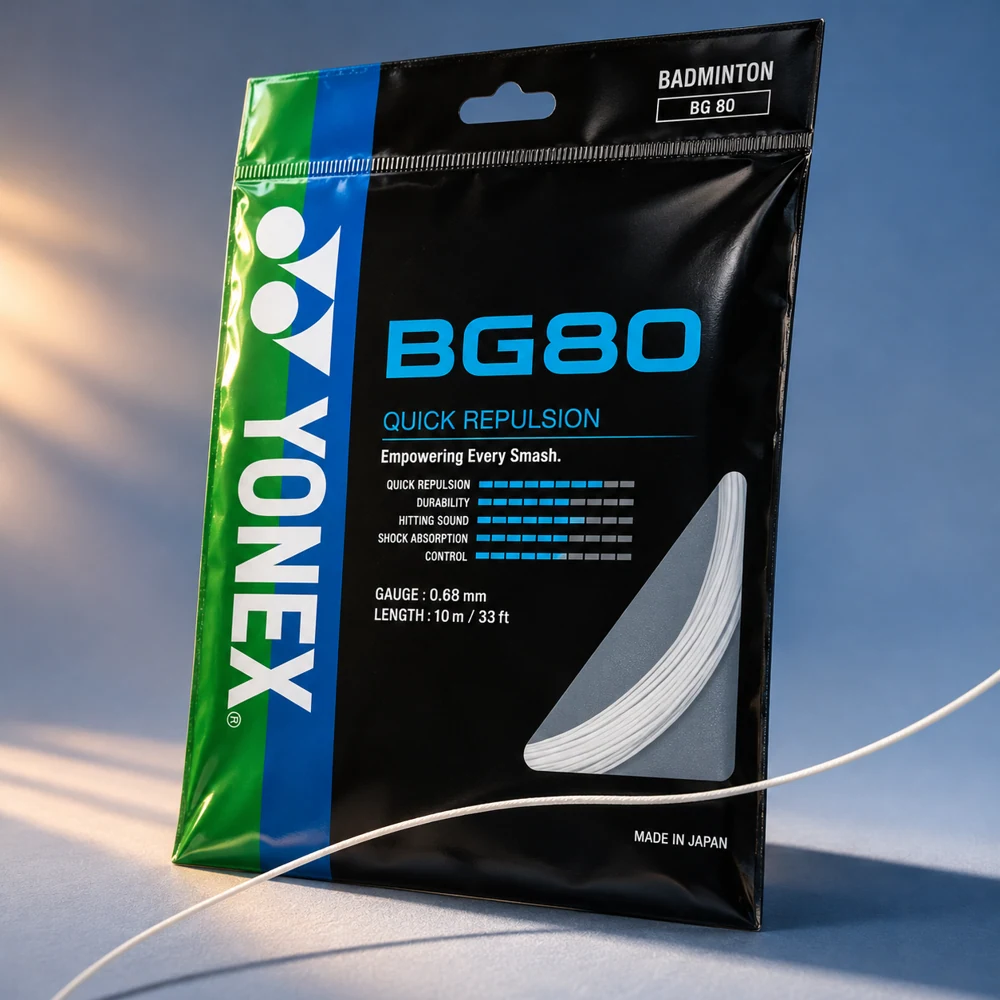
Yonex BG80 is a 0.68 mm badminton string with a Vectran-blended core and a braided oval nylon outer. If you like firm contact, use this guide to compare its drive, block and net feel before restringing at ERR in Setapak.

What makes BG80 different?
BG80 is a single-gauge nylon badminton string, identified by product code BG80. Yonex specifies a high-polymer nylon multifilament core with Vectran and an outer braid made with oval-shaped nylon filaments. It is made in Japan. BG80 Power has a different code, BG80P, and a different published construction description; the two should not be treated as interchangeable names.
The useful question is whether you enjoy a definite, firm sensation at contact. Yonex places BG80 towards the hard-feel side of its string chart. That positioning describes a product characteristic, not a skill requirement or a promise of harder smashes. If you are changing from a softer-feeling string, assess touch on blocks and clears as carefully as your attacking shots.
A single BG80 set contains 10 metres. Yonex also lists a 200 metre reel. For a setup history, write BG80 and the colour on your record. The same label on a reel or packet identifies the model, while BG80 Power carries a different item code. When comparing two jobs, that distinction is more useful than remembering that both strings looked white.
Players often notice the firmer contact first on a short punch clear or a flat return. Try your normal contact point and grip pressure for several shuttles. A setup that feels exceptionally sharp when you catch the middle can still be hard to manage when you are stretched late. The two situations are worth observing separately.

Firm feedback in compact exchanges
A player who wants a clear sense of shuttle contact may find BG80 worth discussing. During a trial, alternate controlled drives with soft blocks: notice whether you can change the length of the return without gripping excessively. A firm sensation that feels precise to one player may feel abrupt to another. The racket, shuttle, tension and contact location all contribute to that difference.
Separate rebound from effort. A sharp sound or a short contact sensation does not establish that the shuttle travelled faster. Use familiar targets and comparable feeds to judge whether placement and length are easier to reproduce. If you need a large extra swing just to clear, revisit the setup and timing instead of assuming that a hard-feel string must be used at a high tension.
For a doubles comparison, have your partner feed a predictable run of waist-high shuttles across your body. Alternate between sending the shuttle back flat and taking the pace off into the forecourt. If the drive is easy but the block repeatedly sits high, write down that particular combination. It gives your stringer something actionable to ask about.
Run a separate net exercise with a gentle push and a tight tumble from the same starting place. String feel is only one factor in how the shuttle leaves the racket. Grip changes and racket-face angle can dominate the result, so see whether the same pattern appears over a second session before treating it as a setting issue.

Gauge and texture: different questions
The 0.68 mm figure is BG80's nominal diameter. It does not measure stiffness, surface friction or the size of your sweet spot. Its published oval-shaped braided outer construction is relevant when discussing its textured feel, but the surface cannot be reduced to a numerical grip score without a defined test.
For a useful comparison, describe what happens at the shuttle: does a gentle net shot leave too quickly, does a block feel predictable, or do strings move after a rally? Those observations are more useful than asking for the roughest string. Texture alone cannot correct a late racket face or determine shot direction.
BG80 Power shares the 0.68 mm diameter, which makes it an interesting comparison for anyone who wants to keep gauge stable. A fair test uses the same racket model, the same requested machine setting and a similar stage of string wear. Comparing fresh BG80 to a heavily used BG80 Power bed can tell you what you prefer today, but it leaves the model difference uncertain.
The braid is a construction detail you can discuss without assigning a numerical grip advantage. Note how you place a slow shuttle, whether your usual wrist action feels comfortable, and how frequently the centre intersections need inspection. These observations offer more than a finger test on the loose string, particularly if you are moving from a smooth-feeling setup.

Choose tension around your current racket
Bring the exact racket model and weight version, its condition, the previous string and requested tension. BG80's firm-feel positioning is a reason to discuss your starting point, not a reason to apply one fixed number to every racket. The frame manufacturer's permitted range and applicable stringing instructions remain the limits for the job.
Do not add a universal percentage to the crosses or automatically request pre-stretch. Main/cross settings, pulling procedure and knot locations belong to the racket-specific installation plan and equipment being used. An old racket with worn grommets or damage may need attention before a new string can be considered.
Keep your first comparison manageable. If the old setup felt demanding, explain the difficult shot and when it happens. Agree on one change, keep a record, and compare under familiar conditions. A new grip, different shuttle and different tension introduced together make it harder to understand what BG80 actually changed for you.

A textured string still needs wear checks
BG80 should not be chosen on the assumption that 0.68 mm guarantees a certain number of weeks. Wear at intersections, off-centre strikes, tension and grommet condition can all change the replacement interval. Its manufacturer profile is not a calendar and does not establish how long your stringbed will last.
Look for the pattern rather than one broken strand in isolation. Gradual fraying or notching in the hitting area is different from repeated breaks beside one frame hole. Photograph recurring break locations before your next appointment. Ask for a grommet and frame check instead of repeatedly replacing the string without examining the cause.
A bed may stop giving the response you want before it breaks. Keep notes about playing hours and the point when touch or length becomes less consistent. For a player whose first priority is fewer replacements, compare a durability-positioned option such as BG65, while remembering that another string cannot repair a damaged frame or grommet.
For a useful wear note, record the position in simple court terms such as centre, upper centre or near the rim at a specific hole. Pair that note with roughly how many sessions the bed has seen. A sharp-feeling bed that remains playable and a chronically damaged grommet can coexist, so bring the racket for inspection before making a purchasing decision.
Who should consider BG80?
Consider BG80 when you already know you prefer firm, distinct feedback and want to compare that sensation with your current setup. It can be discussed for singles or doubles: the event name does not determine the best string. Players who value touch on controlled strokes should include net exchanges and blocks in their trial rather than judging only full-power hitting.
If you dislike abrupt feedback, frequently mishit near the frame, or want the lowest ongoing restringing cost, do not choose BG80 solely because it is familiar to other players. A different feel or a durability-oriented construction may fit your priorities better. Beginners are not automatically excluded, but an appropriate tension and consistent contact matter more than choosing a famous model.
Define one success criterion before booking. For example, you may want blocks to land more consistently without making clears feel difficult. After a few comparable sessions, note both the improvement and the compromise. Keeping BG80, adjusting the setup or moving to another model can each be a sensible outcome.
Keep BG80 on the shortlist if you can repeat both your fast drives and your gentle returns with normal effort. If only one stroke improves, decide how often you actually rely on it. A club doubles player who spends most points in drive exchanges may make a different selection from someone who values easy defensive length.
BG80 Knowledge Check
How well do you know this string?
0 / 8 answeredYour result
Review each answer, then try again when you are ready.
| Nominal gauge | 0.68 mm |
|---|---|
| Product code | BG80 |
| Retail set length | 10 m |
| ERR restring | RM48, string and labour |
See the response profile
Five-characteristic spider chart
Contact, deflection and rebound
Press play to follow contact → deflection → rebound.
Slow-motion teaching diagram, not a measured speed or tension test.
The numbers behind the feel
Yonex's 2026 catalogue rates BG80 across five characteristics. These are brand-relative values, not ERR measurements, percentages or a cross-brand ranking. The chart uses an 11-point display because the catalogue includes scores above 10.
BG80 DT over three days
-
Day 162–64 DT
-
Day 254–57 DT
-
Day 351–56 DT
Recorded range Range midpoint
These readings describe an earlier installation. Use them to understand the recorded change across days.
BG80 and three alternatives
Compare construction and priorities rather than treating a model name as an upgrade ladder. These are different options, not a controlled ranking.
| String | Gauge | Construction or feel | What to check on court |
|---|---|---|---|
| BG80 | 0.68 mm | Oval-shaped nylon braid; Vectran in core | Try controlled drives and blocks |
| BG80 Power | 0.68 mm | Different published core and outer specification | Same gauge does not mean same feel |
| BG66 Ultimax | 0.65 mm | Nylon multifilament and braided outer | Assess wear and touch together |
| BG65 | 0.70 mm | Braided nylon construction | Consider maintenance priorities |
BG80 Power is not simply BG80 at a different tension. BG65 and Ultimax also differ in construction and diameter. Keep the racket and testing routine consistent before drawing conclusions about your preference.
What would you like to feel differently?
For BG80, begin with the feel you want to change: firm contact, short clears, wear or a changing response. A new packet cannot resolve every racket issue.
Track the change, not just the sound
Some settling after stringing is normal. Record when the racket starts to feel different, the hours played and storage conditions. Compare readings using the same method; a phone frequency reading is not the machine setting in pounds. Ask about installation consistency before assuming a different packet will solve it.
Bring this question to ERR →Separate contact from setup
A stiff-feeling bed, late contact, shuttle speed and technique can all make length difficult. Start with relaxed clears and describe where the shuttle lands. Review your current tension within the racket limit rather than increasing it automatically.
Bring this question to ERR →The break location matters
A break near the same grommet deserves a frame and grommet check. Breakage after off-centre contact differs from gradual notching in the centre. Bring the racket and a photo of the break; do not assume every early break means the string is defective.
Bring this question to ERR →Describe what your hand notices
Tell the stringer which shots feel unforgiving and when the sensation began. Compare contact consistency, string choice and tension. Stringing advice is not a treatment for persistent pain; stop playing through pain and seek appropriate assessment.
Bring this question to ERR →Inspect before installation
Photograph existing chips and discuss cracks, worn grommets and frame shape before work begins. Correct support, the appropriate pattern and staying within the racket limit matter. A chipped finish alone does not establish who caused damage.
Bring this question to ERR →Explain the change clearly
Grip size, balance, racket weight, stringbed response and timing are different things. A restring does not turn a head-heavy racket into a head-light one. Tell the stringer what changed and compare with your previous setup instead of asking only for more power.
Bring this question to ERR →What matters on court?
Choose what you want from your next restring.
Try two speeds in one drive drill
Use the same flat feed for a compact drive and a soft block. BG80's firm feedback is most useful if you can still take pace off comfortably with the same grip.
Ask your stringerCan I keep this drive feedback without making my blocks sit up?
Check the high-contact area
Look at the central crosses after comparable playing hours. If breaks recur at a single hole, bring the racket so ERR can inspect its grommet before testing BG80.
Ask your stringerDoes the wear pattern point to the string or the frame?
Check length from a late position
After ordinary clears, try a few controlled clears from slightly farther behind you. Note how much effort you need before changing the tension in your frame.
Ask your stringerWould this feel better with a small tension adjustment in my racket?
Compare BG80 with BG80 Power
Both are 0.68 mm, with separate construction descriptions. Judge the two on short placement and your usual drive tempo at a comparable setting.
Ask your stringerHow should I set up a fair BG80 and BG80 Power comparison?
Different equipment. Different questions.
Different rackets
The same requested pounds can feel different across frame shapes and stringbed dimensions. Record the racket, not just the number.
Try BG80 on the same racket first. Record the full racket model and the agreed tension before trying another frame.
Different strings
Gauge, construction and surface feel change the comparison. Do not treat every thin string as the same product.
Compare BG80 with BG80 Power using the same racket and familiar shots. Use the table above to check gauge and construction before changing the setup.
Different installation
Machine calibration, support, clamps, pattern and technique can affect consistency. Ask about the process as well as qualifications.
If BG80 repeatedly breaks near the same hole, show your stringer a close-up of that spot and ask them to inspect the grommet.
Different sessions
Shuttle speed, hall conditions, fatigue and timing influence feedback. Compare familiar drills before drawing a conclusion.
Use the same shuttle speed and repeat a few clears, drives and net shots. Record playing hours alongside any change in how BG80 feels.
Prepare, play and review with purpose.
Bring your racket history
Note your racket model, previous string, requested tension and the change you want. A photo of recurring breakage helps.
Make the plan specific
Review the frame and grommets. Confirm string, colour availability, tension within the racket limit and price before work starts.
Keep a useful record
Keep the string model, requested tension and date together. Ask about the pattern and checks relevant to your racket.
Repeat familiar shots
Try clears, drives, blocks and net shots under comparable conditions. Record comfort, length and placement, not only sound.
Change one thing at a time
Bring your observations back. Keep the setup if it works; otherwise agree on one practical change for the next restring.
BG80 questions, clearly answered.
Is BG80 the same as BG80 Power?
No. BG80 and BG80P are separate product codes. Both are 0.68 mm, but Yonex lists different core and outer-construction descriptions. Compare their feel rather than assuming Power means the same string pulled tighter.
What is BG80 made from?
Yonex specifies a high-polymer nylon multifilament core with Vectran and a special braided oval-shaped nylon outer. The nominal gauge is 0.68 mm; this does not imply a single solid Vectran string.
Is BG80 a hard-feeling string?
Yonex places BG80 towards the hard-feel side of its product chart. The finished sensation also depends on your racket, tension and contact. Firm feedback can feel clear to one player and demanding to another.
Does BG80's rougher feel guarantee better control?
No. Surface feel is only part of the setup. Compare placement during net shots, blocks and drives with the same racket and familiar feeds. A textured surface does not correct timing or racket-face errors.
What tension should I choose for BG80?
There is no universal BG80 tension. Start with your racket's permitted range, frame and grommet condition, previous setup and contact consistency. Discuss the change you want before selecting the setting.
Should I automatically add pre-stretch or extra cross tension?
No. These are installation choices to assess against the racket instructions, string and machine procedure. Do not copy a percentage from another player's setup as a rule for every racket.
Does BG80 last longer than BG66 Ultimax?
Diameter alone cannot establish lifespan for your play. BG80 is 0.68 mm and Ultimax is 0.65 mm, but construction, tension, wear and mishits also matter. No controlled ERR lifespan comparison is presented on this page.
Does BG80 hold tension for a fixed number of days?
No fixed period is established here. A useful comparison records the same racket, measurement method, elapsed time and playing hours. Machine pounds, stringbed dynamic response and phone frequency are different readings.
My BG80 breaks near the same hole. Should I change brand?
Have the frame and grommet inspected first. Repeated edge breakage can have a different cause from gradual centre wear. Bring the racket and a photo of where the break occurred.
Would BG65 or BG66 Ultimax suit me better?
Discuss BG65 when abrasion durability and maintenance are priorities. Discuss Ultimax when you want to compare a thinner, quick-response option. Neither comparison determines a guaranteed winner without your racket and playing context.
How much is BG80 restringing at ERR?
The ERR string list checked on 14 November 2026 lists RM48 including string and labour. Confirm the current price, colour and availability before making your appointment.
What should I send before booking BG80 in Setapak?
Send your racket model, current string, previous tension, playing frequency and the feel you want. Use ERR Member for appointments or the BG80 WhatsApp enquiry on this page. Check the Taman Melati Utama map before travelling.
How did Yonex BG80 play for you?
Your experience can help another player choose their next string.
What players say
Your first-hand experience matters.
Be the first to review Yonex BG80. Share what you liked and what could be better.
More badminton string reviews.
Take a closer look at other strings before choosing your next setup.


Ready to discuss your string setup?
Bring your BG80 questions, racket model and previous setup. Discuss the contact feel you want before choosing the next restring.
Book stringing Explore the string listBook stringing.
Bring your racket and questions.
Discuss your BG80 setup with ERR before visiting. Tell us your racket model, previous tension and the shot or feel you want to review.
Book through ERR MemberAsk ERR on WhatsApp ↗Prepare a question for your visit
Open WhatsApp with my question ↗You can review your message in WhatsApp before sending.By appointment · Check available slots before travelling.
Find us in Taman Melati Utama
G-3, PV6 Platinum Hill Condo, No. 3 Jalan Melati 3, Taman Melati Utama, 53100 Kuala Lumpur, Malaysia.
Get directions in Google Maps ↗
